Production audio is messy. A caller on speakerphone with a television behind them. A meeting where two people finish each other’s sentences. A kiosk in a food court. Every voice product eventually has to answer the same question: who is talking, and which words are theirs?
Three families of techniques answer that question: speaker diarization, speech separation, and speaker extraction. The terms get used interchangeably. They shouldn’t be. They take different inputs, return different outputs, and fail in different ways. This guide defines each one, shows where each breaks, and tells you which one your pipeline actually needs.
What is speaker diarization?
Diarization answers “who spoke when.” Given a recording, it divides the timeline into segments and assigns each segment an anonymous label: Speaker 1 from 0:00 to 0:14, Speaker 2 from 0:14 to 0:22, Speaker 1 again after that.
The classical pipeline runs in stages: detect where speech happens, cut it into segments, compute a voice fingerprint for each segment, then cluster the fingerprints so that segments from the same voice share a label. Newer systems fold those stages into a single model, but the contract is unchanged. The output is a timeline of turns, and the names on those turns are made up.

Diarization is the right tool for adding structure to recordings after the fact. Meeting notes, podcast transcripts, call analytics: anywhere “Speaker 2 said this at 3:41” is a useful sentence.
Its failure modes follow directly from the design:
- The labels are anonymous. Speaker 2 is a cluster, not a person. Nothing connects Speaker 2 in today’s call to Speaker 2 in yesterday’s, and a label can silently swap owners mid-recording.
- Overlap is a blind spot. A segment gets one label. When two people talk at once, one of them loses their words, or worse, keeps someone else’s.
- Streaming hurts. Clustering works best when it can see the whole recording. Run it live and it revises history: the label your application already acted on may change.
What is speech separation?
Separation answers “what individual signals make up this mixture?” Give it one audio stream containing several voices and it returns several streams, one per source. It is the direct descendant of the cocktail-party problem: unmix the room.

Separation is the right tool when the goal is the audio itself: cleaning up a recording, splitting sources for editing, preparing training data.
Its failure modes are just as structural:
- The streams have no names. Separation hands you voice A and voice B. Which one is your customer is not its problem. The literature calls this the permutation problem; in production it means you still need another system to decide which stream to trust.
- It wants to know how many speakers there are. Real scenes don’t announce that, and the count changes mid-scene when a door opens.
- Real rooms are hostile. Streams can trade places when voices cross, and each output can carry traces of the others.
What is target speaker extraction?
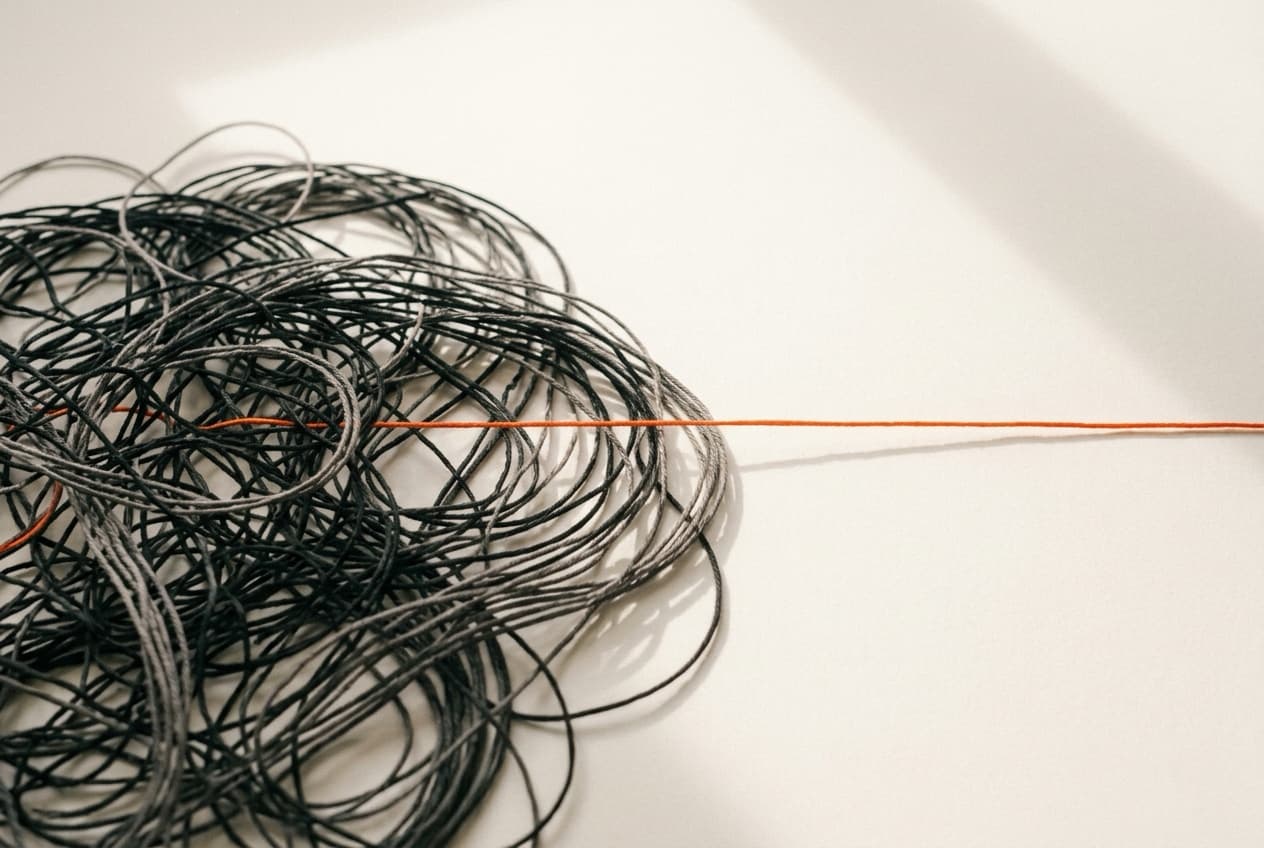
Target speaker extraction, TSE in the literature, is the technique of pulling one known voice out of a mixed recording. You give the system a short reference of the voice you want, an enrollment, and it follows that voice through the scene and returns it alone. Everything else is treated as interference. Other voices, the television, the street: all of it, regardless of how many sources there are.
Where diarization answers “who spoke when” and separation answers “what signals are in this mixture,” extraction answers “what is this person saying?” Identity is part of the question from the start.
This is the machine version of what you do at a loud party. You don’t unmix the whole room into tracks. You pick one voice and attend to it.
Three properties make this shape fit production:
- Identity is the input, not an afterthought. There are no anonymous labels to reconcile. The output stream belongs to a known person by construction.
- No speaker count required. The scene can hold two voices or ten; the target is defined by the reference, not by the room.
- It composes. Put extraction at the front of the pipeline and everything downstream sees one voice. Transcription, understanding, and turn-taking all get the clean, single-speaker input their models were trained to expect.
Extraction has honest requirements of its own. It needs an enrollment, a reference of the target voice, before it can follow anyone. And when the target isn’t speaking, the correct output is silence; knowing the difference between “quiet” and “absent” is part of the job.
This is what Crele builds. The batch version is the free isolation tool, and the live version is the real-time speaker extraction engine, which is coming soon.
Side by side
| Diarization | Separation | Extraction | |
|---|---|---|---|
| Question answered | Who spoke when? | What signals are in the mix? | What is this person saying? |
| Input | The mixture | The mixture | The mixture + a reference voice |
| Output | Timeline of anonymous turns | One stream per source | One stream, one known speaker |
| Knows who anyone is | No (clusters) | No (unnamed streams) | Yes (the enrolled speaker) |
| Overlapping speech | Weakest point | Handled | Handled |
| Needs a speaker count | Roughly, for clustering | Usually | No |
| Built for | Recordings, after the fact | Audio as the end product | Live pipelines serving a person |
Which one do you need?
Structuring recordings after the fact. Meeting summaries, podcast chapters, compliance review: diarization. It’s mature, it runs offline where its weaknesses matter least, and anonymous labels are often acceptable when a human reads the result.
Unmixing audio as the deliverable. Editing, restoration, dataset preparation: separation. You want every source, and you can sort out names later, or never. If you are trying to do this inside an audio editor, note that most of the effects that sound like they should help were built for music; what each one actually does is its own post.
A live product that serves one known person in a messy scene. A voice agent on a phone line, a contact-center pipeline, a wearable or any AI hardware with a microphone: extraction. The moment your product needs the customer’s words and only theirs, anonymous turns and unnamed streams both leave the same gap, and teams end up patching it in application code with heuristics over diarization labels, confidence thresholds, and rules like “ignore audio while the agent speaks.” The gap isn’t in the models. It’s in the front of the pipeline, which never learned who it was listening for.
The three also compose. Extraction in front of transcription removes the crosstalk that breaks it. Diarization over what remains gets easier when the main voice is already accounted for. But composition only works if identity enters the pipeline somewhere. The earlier it enters, the less the rest of the stack has to guess.
Common questions
Which one do I need for meeting transcripts? Diarization, if the audio is clean and anonymous labels are acceptable; it is the standard tool for structuring a recording after the fact. If the transcript keeps attributing words to the wrong person, the problem is usually overlap or background voices, and that is a job for extraction in front of the transcriber.
Why does diarization fail on overlapping speech? Because it assigns each stretch of the timeline to one speaker. When two people talk at once, the segment can only carry one label, so somebody’s words are lost or handed to the other person. Overlap is not an edge case in real conversation; it is the texture of it.
Is speaker diarization the same as speaker identification? No. Diarization clusters a recording into anonymous turns; Speaker 2 is a label, not a person. Identification matches a voice against known, enrolled voices and returns a name. Extraction sits past both: it uses a known voice not to label the timeline but to pull that voice out of the audio itself.
Why this matters now
Voice AI has crossed into production at scale, and production audio is messy in ways demos never are. At the same time the stack is shifting toward real-time, speech-native models, which makes the front of the pipeline matter more, not less, because everything downstream inherits whatever the ears let through.
The scientific ingredients for speaker-aware audio have matured. What’s been missing is neutral, production-grade infrastructure: the identity layer of the audio stack.
That’s what we’re building at Crele: a real-time speaker extraction engine, coming soon. If your pipeline has ever transcribed the television, join the waitlist.